
Lock Picking Mechanic!
Quick, easy and effective lock picking using a cube maps.

I’m rather excited this week to present my newest, and first mechanic using the Cube Maps I introduced last week. After spending a few evenings staring into the abyss with a pencil in hand, the abyss finally started to stare back into me, finally I felt like I was motivated to do something and worked out a simple lock picking mechanic.
As a reminder, a cube map is an abstract representation of any given space, real or not, known or unknown. In this case, that abstract space happens to be the inside of a lock and maps out the locks tumblers. Below are some examples of lock designs, of varying degree, including one example with a trap.
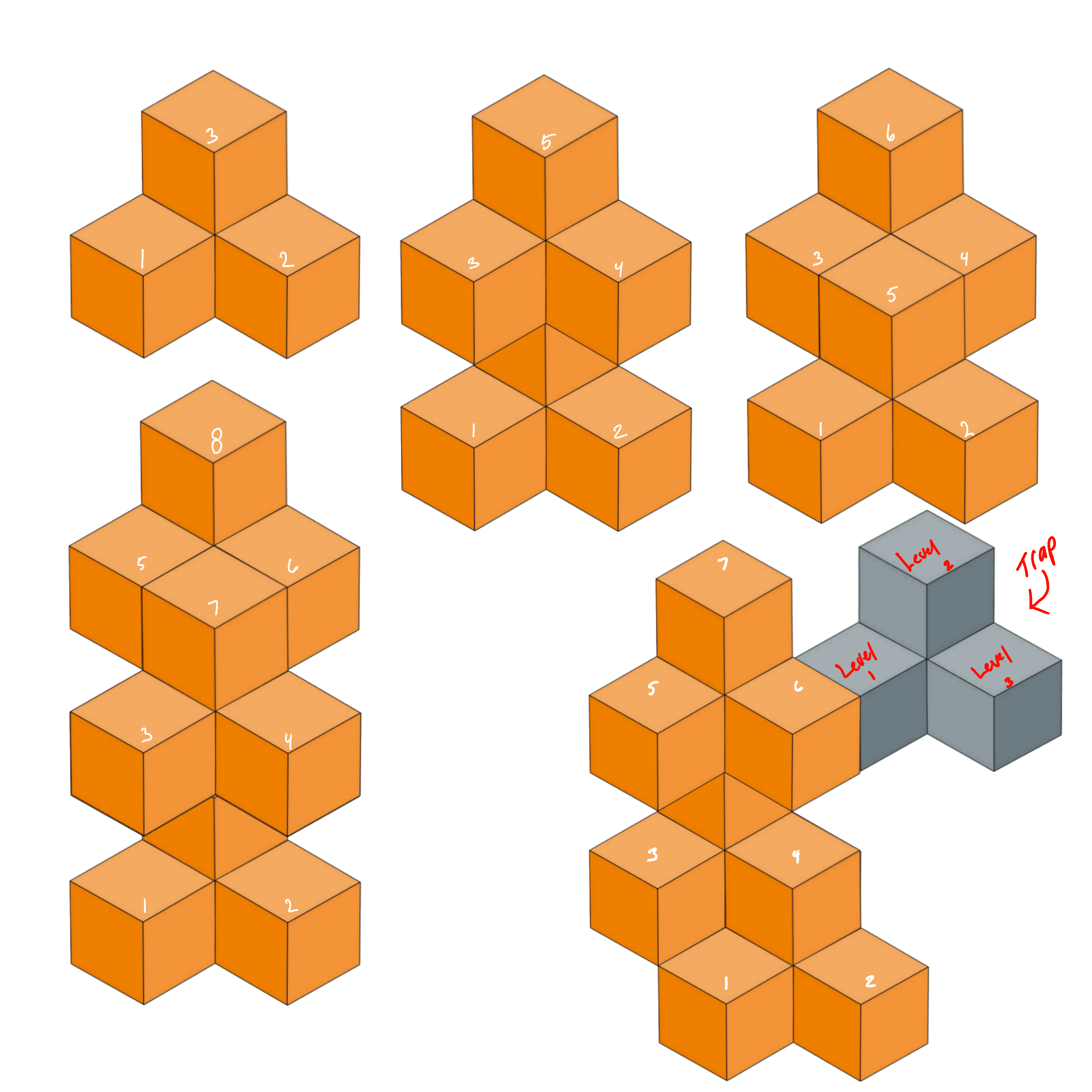
This is a representation of five different lock types I build very easily. And their shape can vary as well as add to the difficulty of the lock. There can be any number of tumblers per lock and the shape can very wildly. For example, take a look a the following 3 and 4 level locks:
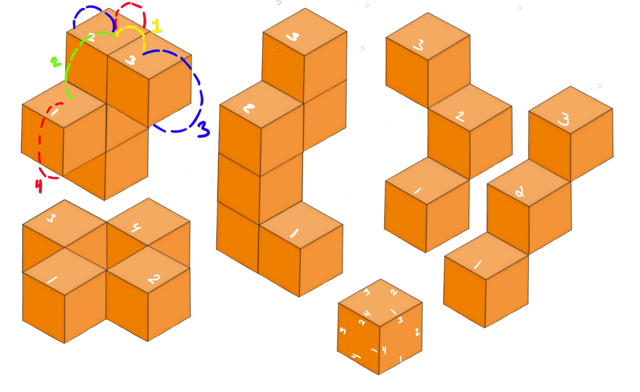
The above only really matters if you are implementing some sort of movement based mechanic other than a manual one. We’ll get to a different types of movement soon.
I mentioned traps didn’t I? Traps can be setup to only happen on certain, more difficult locks, and or all locks. And I mean, why not? What if I had a secret diary containing much desired information? The lock could be rather simple, but would also be possible to trap such a lock. And traps can very power according to the amount of additional steps it adds, in this case, up to 3 additional steps are needed inside the lock to disarm the trap. That is of course if you happened to notice the trap in the first place. Traps can occur anywhere inside the lock and of course can also replace a tumbler.
Each numbered cube represents a tumbler that must be set before the lock can be fully opened. Movement can dice based (d4’s), or manual. I find either works depending on your personal tastes and needs, however, dice based movement adds a level of difficulty to more complex looking locks like those above.
I’ve created some basic mechanics just for sample use, they work quite well on their own, but could easily be expanded upon. Consider them a base for something more advanced, or use them as is if they work for you. In my opinion they can certainly be worked on.
1. Initial Difficulty Setup:
• Lock Difficulty (LD): Based on the number of tumblers.
• Player Skill Bonus (PSB): Varies from +0 to +5.
2. Roll to Set Tumblers:
• Roll 1d12 and compare to the target number (12 - LD + PSB).
• If the roll is equal to or lower than the target number, the tumbler is set.
3. Loose Tumbler Mechanic:
• On a roll of 1 on the 1d12, the tumbler is loose.
• Roll 1d4, for each consecutive turn with the 1d12 and if a 1 is rolled on the 1d4, the tumbler falls and must be reset.
4. Success Thresholds:
• Easy Locks: 3-4 tumblers, LD = 3-4
• Moderate Locks: 5-6 tumblers, LD = 5-6
• Hard Locks: 7-8 tumblers, LD = 7-8
To add movement based mechanics to the above method simply use 1d4 and use the resulted value as the direction of movement. All other rule aspects remain the same as above. Players can use 2d4 and pick one value that suits their strategy best as well.
Further, a players level and or skill can, and really should effect the number of tries, how often a lock picks break, as a well as any skill based bonuses, up to a maximum of four, maybe even five. Anything more and it becomes to easy, I find. Perhaps some lock picks are cheaper than others and break more often. Perhaps some locks could require special, expensive lock picks.
A sample way of breaking down a thief’s experience, simply for the sake of example:
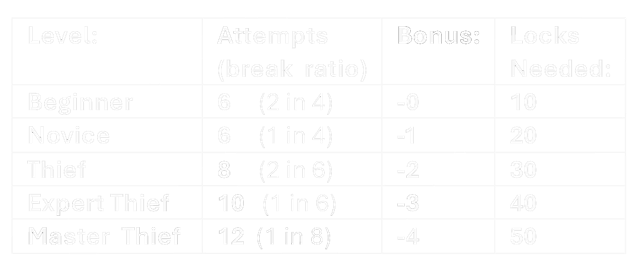
Note the ‘Break Ratio’ (BR) is the chance of a lock pick breaking after the number of attempts are made. For example, a Novice player, after 6 uses of a single lock pick, there is a 1 in 6 chance of it breaking, i.e. a roll of 1 on a 6-sided die. A player can get up to a +5 bonus, however, it’s possible only through more expensive lock picks used on more challenging locks.
And yes… traps!
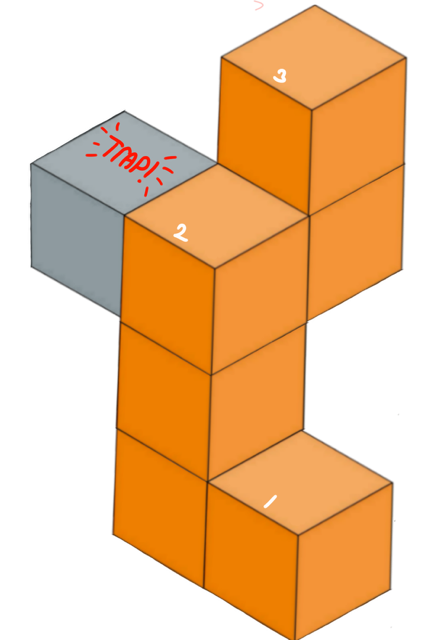
Traps, are potentially detected whenever you roll 12, on the 1d12. However, it might also be a false alarm. The example above is level 1 trap, likely powerful enough to destroy the lock you’re trying to pick if it’s explosive, or it could simply be an acid that melts and then quickly hardens the metal inside the lock, rendering it unlockable by traditional means.
Revised Lock-Picking System with Traps
1. Initial Difficulty Setup:
• Lock Difficulty (LD): Based on the number of tumblers.
• Player Skill Bonus (PSB): Varies from +0 to +5.
2. Roll to Set Tumblers:
• Roll 1d12 and compare to the target number (12 - LD + PSB).
• If the roll is equal to or lower than the target number, the tumbler is set.
• If a 12 is rolled, the tumbler is potentially trapped.
3. Trap Detection:
• When a 12 is rolled, roll 1d12 again to determine if the tumbler is trapped.
• Compare the roll to the Lock Difficulty (LD):
• If the roll is equal to or lower than the LD, the tumbler is trapped.
• If the roll is higher than the LD, it’s a false alarm, and the tumbler is safe to set.
4. Disarming Traps:
• If a trap is detected, the player must attempt to disarm it.
• Roll 1d12 and compare to the target number (12 - LD + PSB):
• If the roll is equal to or lower than the target number, the trap is successfully disarmed.
• If the roll is higher than the target number, the trap is triggered.
5. Trap Effects:
• Determine the effect of the trap (e.g., lose a turn, noise increase, damage taken):
• Roll 1d12:
• 1-4: The lock is damaged - Tumblers directly surrounding the damaged tumbler require two rolls to set.
• 5-8: Increase noise meter by 1
• 9-12: Take damage (1d6 or another suitable measure)
Simply choose your method for working from tumbler to tumbler, ether by manually moving from 1 to 2, to 3 etc, or by using the d4 movement method mentioned earlier. For example, let’s take a look at the following scenario that takes place once a tumbler has already been chosen:
Scenario: Moderate Lock (LD = 5) with Traps
1. Player attempts to set a tumbler:
• Roll 1d12 and compare to the target number (12 - 5 + PSB):
• If the roll is equal to or lower than 7 (assuming PSB = 0), the tumbler is set.
• If a 12 is rolled, the tumbler is potentially trapped.
2. Trap Detection:
• Roll 1d12 again and compare to LD (5):
• If the roll is equal to or lower than 5, the tumbler is trapped.
• If the roll is higher than 5, it’s a false alarm.
3. Disarming the Trap:
• If the tumbler is trapped, roll 1d12 and compare to the target number (7):
• If the roll is equal to or lower than 7, the trap is disarmed.
• If the roll is higher than 7, the trap is triggered.
4. Trap Effects:
• Roll 1d12 to determine the effect:
• 1-4: Lose a turn
• 5-8: Increase noise meter by 1
• 9-12: Take damage (e.g., 1d6)
Simple and effective and with or without the cube map, however, the cube map can add challenging aspects that are not present otherwise. Not to mention the visual sensory adds to the overall experience in my opinion.
If movement isn’t making a whole lot of sense to you, check out last weeks post, where I go into more detail and have better examples. If it still makes no sense to you, let me know.
That’s it for this week, I hope you find it interesting and useful.
Tephrotic Nightmares has been released and is available over at Exalter Funeral. I ordered a copy this morning along with The Job and FireDrop. The first two aren’t inherently solo, however, I’ll be reviewing and adding my tips for playing them solitaire in a future post. FireDrop, is a solitiare “hex and dice wargame” that was on the recent release list so I picked that up also and I’ll be reviewing that as well in the coming weeks.
Everyone have an amazing week and make the best of what comes your way. As always I appreciate you all very much. Remember to take care of yourselves and watch out for one another and I’ll see you next week.