
Randomness Masquerading as Skill
The Weight of Mastery — Skill Checks That Actually Feel Like Skill

This place breathes differently in summer, you recall from distant memory. The air is thick and warm and holds the smell of things growing quietly in the dark. The moon, full, splashes along the contours of the silhouetted plants and tall grass, like something caught between burning and dreaming, the spaces between them pooled in soft shadow. You have been walking for a while now. Long enough that the sounds of everything else have fallen away, and all that remains is the sound of your own footsteps, and the occasional shift of something unseen moving politely out of your path.
Ahead, the trees thicken and lean toward one another until forming an archway of darkness that leads deeper into the forest. A low fog clings to the roots and stones, unhurried, uncommitted, drifting as though it has nowhere else to be.
The path beneath your feet is barely a path at all anymore; more of a suggestion, a faint impression, overgrown, forgotten.
A small, shack-like building announces itself only once you’re nearly upon it. Small, weathered, the kind of structure that looks like it grew here rather than was built. Stepping inside, it feels familiar, and widens like a mouth swallowing you whole. The space opens with a downward slope, there are various seats, scattered tables are present here; others are already seated, still and patient, their faces soft in the low light. Something cool and gentle at your shoulder guides you to your place without a word; you don’t look to see what it is. At the center of the room, a hooded figure sits quietly, waiting. You settle into your seat. The air shifts slightly and the audience quiets as some unknown force has interrupted them.
…and… welcome back everyone. I know, it’s been too long. But I had a really hard time trying to find a way to step back into this. It’s more than just a blog to me, it’s a sacred space. It took me a long time to approach it again; feeling like I’ve got a lot behind me and how do I step back into after so long…
The answer as turns out, is just doing it. Starting again from here, and seeing where we can go.
Starting with a look at something I’ve wanted to explore for a while, but if you know, I tend to overcomplicate things and simplicity is what really keeps the narrative rolling, not a bunch of complicated mechanics right?
I’m going to try and keep this as simple as possible once I explain it a little first. I’m wordy, I can’t help it. This is exciting to me, and the part that holds the most dopamine.
Randomness Masquerading as Skill
The standard skill check model (roll d20, add modifier, beat DC) conflates two things that should be separate: what a character can do and whether they happen to do it right now. When a master lockpick fails a DC 15 check because they rolled a 3, it not only breaks the fiction, but it isn’t very realistic.
The dice aren’t simulating skill, they’re simulating pure cosmic interference.
Most of you likely know I’ve developed a sense of disdain for random dice rolls. They have their place naturally, but determining whether or not someone is skillful, shouldn’t be left up to random values being rolled, the roll should be affected by the skill level of the person performing the task, don’t you think?
If I’ve got a character with a high skill level, I want that to reflect effectively and in a way that mimics some of the skill of the person making the attempt. I’ve worked out, what I feel is the best way to solve that issue, and naturally it’s the power of probability, which as you may know, we have the power to skew to match our expectations.
Think of it as having some control over things you don’t normally have control over. I’ve gone over it before, but let’s take a quick look at the power of probability first.
Skill as Probability Architecture
Think of rolling two six-sided (2d6) dice as a bell curve. Some values will be more common than others with 6-8 being the more common sums rolled.
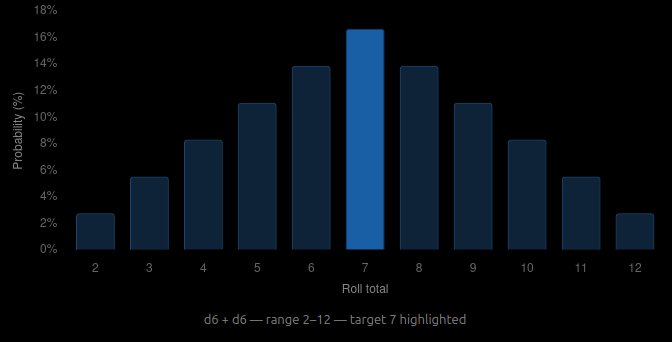
The outcomes naturally cluster in the middle, making average sums (like rolling a 7) much more likely than extreme highs or lows like 2 and 12. This happened because now there are various pairs of numbers that add up to the center values than say, 2 and 12, where only 2 values will equal those amounts.
Only double 6’s and 1’s will equate to those outer results. While there are 6 total pairs that add up to 7. They are: (1, 6), (2, 5), (3, 4), (4, 3), (5, 2) and finally (6, 1) reversed. Since we treat the dice as distinct (e.g., a 1 on the first die and a 6 on the second is different from a 6 on the first and a 1 on the second), we count both versions.
What this means is that you’re more likely to roll a 7 than any other value. While the outcome is still technically left up to randomness, we have quite a bit more control over the result. And if we want to tighten those results even more we can decrease the size of the dice. For example, 2d4 (Two, Four-Sided Dice) which looks like this:
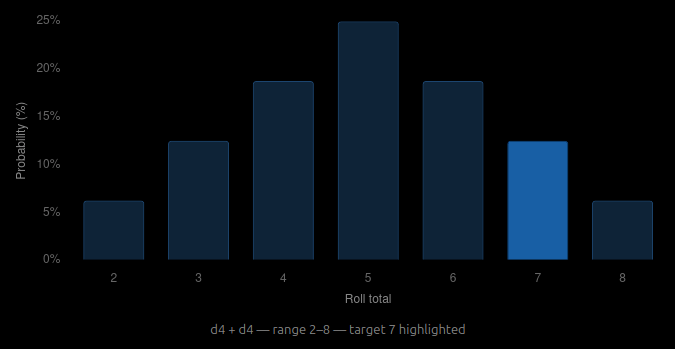
When you switch from 2d6 to 2d4, the “bell curve” spikes much higher and narrower than with two six-sided dice (2d6), There’s a 16.7% (1 in 6) chance of a 7. With two four-sided dice (2d4), the center drops to 5, and your chances of hitting it jump to 25% (1 in 4). That means you are 8.3 percentage points more likely, or effectively 50% more likely to roll a 5.
The results “tighten” significantly because the range shrinks. With 2d6, your results can spread all the way from 2 to 12. With 2d4, that range is down to just 2 through 8. This forces nearly two-thirds of your rolls to fall within just one point of the center number (now a 5), making the outcome much more predictable and consistent. And, if you didn’t notice, it also increases the chances of rolling one of the less common outliers, a 2 or an 8; so you may be asking how that’s helpful if we’re talking about matching skill level with bell curves; assuming that the lower values are not so great results, which is true in this case.
A curve represents fair, balanced randomness, and it functions really well by itself. But if you start applying “weight”, by manipulating the odds, (+1, -2 etc) that perfect curve gets warped. The weight acts like a magnet, dragging the results toward a specific number and skewing the distribution slightly or even so heavily that it lopsides the bell. If you add enough weight, you aren’t just influencing the odds; you are practically forcing the outcome, collapsing the range of possibilities until the “random” result becomes a near certainty.
Mechanically in relation to roleplaying, we’re not looking to control the results one-hundred percent, though there are times when we might want to, that option is there too. As far as skills go, your character’s skill should impact the rolled results in a realistic way; one that reflects their experience and hard work.
Skill shapes the distribution
A novice has wide variance because they genuinely don’t know what they’re doing and attempts that are better attributed, narratively, to the bits of randomness that still remains, and less tied to skill. An expert has tight variance because mastery means consistency. The randomness that remains models external conditions, the lock’s quality, the lighting, distraction, not the character’s ability to perform under normal conditions.
Skill checks should answer “how well?” not “whether.”
At high skill, the question of whether is already settled. The roll exists to add texture, speed, elegance, side effects, resource cost not to randomly revoke competence the character has earned. This also solves the narrative problem of heroes feeling fragile. Experienced characters in most d20 systems still fail routine more often than they would be using a skill-gated probability distribution like this one. This is of course only if you want your character to feel invested in; which increases the attachment and sense of loss should they not make it. If you play like me... well, do you want to live forever?
Often a good death is just what we need. A chance to start fresh with a reincarnated version of our old character, or someone fresh who’s been secretly following you this whole time, knowing your fate and preparing to take your place for the sake of the quest.
What happens if we’ve been poisoned? Further, some characters may not be as able to perform with background noise, while another might not be effected by such things, but the insects crunching underfoot are another story.
And what about cosmic influence, which you can define as static in the universe, divine intervention, fate, albeit fate feels less random it certainly can be if the PC is not aware of it.
We’re not totally in control of anything. And there’s some relief in that; there’s a lot we can simply let go of knowing that the only control we have is our reaction to what is happening. That means in real life we don’t have to be so reactive to things outside of our control.
What we do control is how much we’re going to influence the outcome by applying some weight. We can apply weight, both negative and positive weight to any given situation thereby influencing where we go next.
We do this in real life also. Everything is a probability and absolutely outside of our control. However, we do have the ability to push weight onto the probability of something happening. We can most certainly decide on something with a given amount of certainty. For example, I know I’m going to finish this sentence, however, there is always a chance I won’t, or cannot for whatever reason. The same goes with anything else. We can choose to (apply weight to) go outside, however, there’s never any guarantee we’ll make it the first time, progress has been made, and we can apply that progress to future attempts.
Things happen, we get distracted, something might come up, we might get killed along the way, there might be some cosmic influence at play.
Cosmic experience is also whatever is going on in the experience being played out. For example:
• Contested actions — opponent skill introduces genuine uncertainty
• Novel situations — outside the character’s trained context
• High-stakes compression — when time pressure collapses normal competence
• Environmental chaos — the situation itself is unstable
A Quick Note about Stats and Skills
It’s occurred to me that I’ve not covered stats (Strength, Dexterity, Charisma) and I think it’s important to cover them. First off, stats and skills are not considered the same thing; but they can be. I know some systems rely on stats as an abstract holder for skills. I don’t do that personally, but if you do, this system will still work for you just the same.
Stats bonuses act as weight, and any other weight, negative or positive will add or subtract from whatever stat bonuses are applied. I’d suggest keeping it to a minimum of 3 points of weight from stat bonuses. If you find this to be, too effective on the results and not realistic, or too easy, feel free to instead drop down one level of mastery and consider the stat bonus as a natural boost in your ability instead of using them directly. They are likely fine at the novice level, but at the master level, the experience can end up being almost always an extraordinary success; that’s likely to lead to boredom.
Skills, they way I see them are sets of abilities, that player characters possess, either through natural talent or through hard work and experience. For me, anyone of any type may learn any skill they’re interested in, therefore class is more a suggestion based on a chosen set of skills rather than forced narrative. My personal interests cross a wide array of boundaries, so it feels a bit absurd trying to place everyone into specific boxes.
You may be wondering about leveling, and I’ll get to that inside the mechanic itself.
What follows is a quick and dirty, simplified to the best of my ability, plug and play model that should fit nicely into just about any box with some minor adjustments as a replacement to some forms of ‘Saving Throws’ and the like that is more suitable (in my opinion) than many existing systems, even though I nag on d20 style mechanics the most.
A Skill-Gated Probability Distribution Model
The Core Idea
Two dice, always. The dice shrink as skill grows. Weight shifts the threshold when the world pushes back.
Everything else is detail in service of those three sentences. We add negative or positive weight as needed or simply to apply/force narrative.
Skill checks should answer “how well?” not “whether.” The dice don’t determine if your character is competent, they model the texture of performance. Skill shapes the distribution; weight models the world around it.
The Die Progression
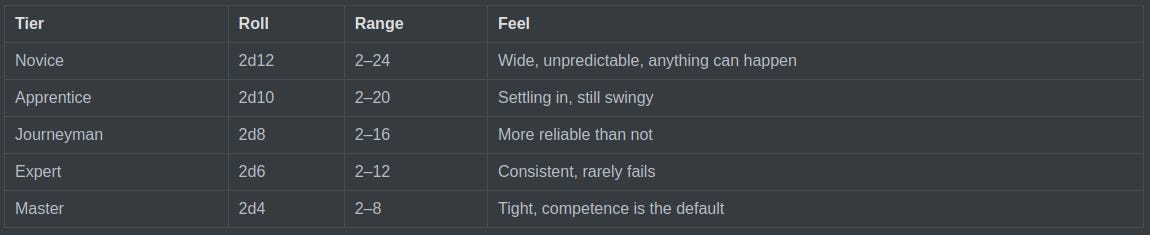
Your skill tier determines which dice you roll. Always two. Always summed. The curve tightens and rises with each step.
The Success Threshold
Success means rolling above the natural peak of your die pair. No numbers to memorize, your dice tell you what average looks like, and average isn’t enough.
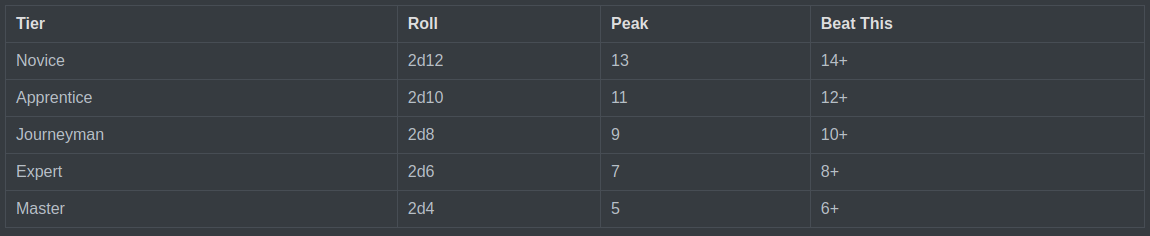
The threshold moves with you. As your dice shrink, so does the number you’re chasing, just like the range between failure and success. If that seems off balanced, keep in mind, we’ve not yet applied any weight. The peak here is the threshold between success and failure. Hitting the peak is nothing more than stepping through the threshold but not putting your foot down on the other side. It’s progress, but not full progress.
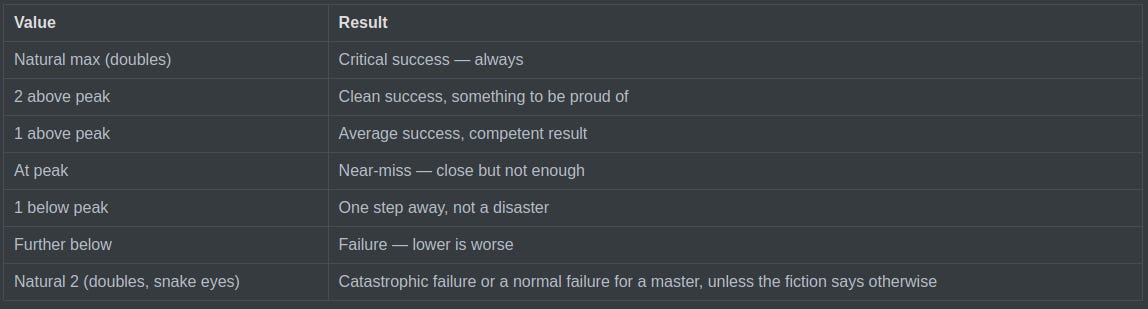
Result Ladder
Optional - Fixed Threshold
If you prefer a single target number that never changes, set success at a fixed value and let the dice shrink toward it. This works well if you like consistency over simplicity. Experiment and use what fits your game and style of play.
Leveling
Leveling is often a personal experience, and what feels earned to you is just as personal. Some players like to move fast, others like to move slow and everywhere in between. There’s no one right way to level up. Experience can be earned by determining how challenging an experience was, from 1-10, then roll a d4 and multiply the result by the challenge number. I’d even go as far as using a d4 -1 or 2 (cannot go below 1), just to keep things tight, depending on your experience system. I’d say using a point system, 1000 is good for me to reach the Apprentice level, then double up after each level reached; 1000 becomes 3000, 2000 + 1000 = 3000, then 7000, etc.
Leveling can be broken down by single weight points as well. Sometimes we want to fine tune things and adding and subtracting weight can help create a very structured character. Keep in mind, that a natural 2 is always a catastrophic failure for anyone below master level. However, you can use your weight to elevate it to a less catastrophic failure if the narrative calls for it, or you’re just not in the mood for it right now. My suggestion is to always chase the narrative, even if it means the end of the line for the current character. I’m playing for the narrative, for the storyline. People die, it happens. That doesn’t mean it’s the end of the line, it just means we change up the narrative. We didn’t get to accomplish that goal this time; we can try again. Fast forward 20-40 years and we’re back in this same situation, reincarnated as some who may or may not look familiar, however, they sure feel familiar...
Or you can start all over again from whatever age you want, and work your way back to the same point with a whole new story, and improvements over the last attempt. Death isn’t the end we think it is, and attachment isn’t the flex we’re told it is. Enjoy the narrative and let the experience unfold in front of you the way it does in real life. If things are not going the way you want, take away some of that negative weight, apply it someplace else, someplace more positive so we push the narrative peak passed the average.
You can of course start characters or pop in characters that are further along. Start with any set of dice that feels correct for you. If you find it you’re winning to often, or losing more often, move up or down as needed, and or apply some weight to help find your sweet spot. No imposed structure. Level up when it feels earned, through a string of strong rolls, a moment where your character clearly knows something they didn’t before, a stretch of play where the fiction reflects genuine growth.
Trust yourself. You know your character better than any system does; make choices that don’t fit inside the box if you cannot find one that fits.
Weight
Weight shifts the threshold while the dice stay pure. The bell curve remains intact; weight is weather. Weather is constantly shifting, it’s not static, even if it stays for a long time; it will eventually change. Dice rolls are often a lot like weather. Sometimes we just keep rolling crap numbers, other times we’re hitting those successes like a master. Most of the time, however, we’re rolling average, but we have the power to apply some weight, and sometimes weight is applied for us.
Positive weight (stress, chaos, opposition, unfamiliar territory) — raises the threshold
Negative weight (flow state, preparation, favorable conditions) — lowers it
Weight is situational and temporary. Your competence never changes. The world around you does.
Weight is generally applied up to 3, but if narrative events, weather, the cosmic hand of the universe, say otherwise, add as much weight as needed. Even if that means forcing or nearly forcing a certain outcome. Imagine there only being a 10% chance of a different outcome, and you just so happen to roll within that 10% range. The narrative shift would be extremely wide and unexpected.
Where Randomness Still Belongs
There’s still some randomness present, we’re never totally in control until we give up control. What we control is how much we push back which is often our common default. These are the moments where variance is honest:
Contested actions — opponent skill introduces genuine uncertainty
Novel situations — outside your character’s trained context
High-stakes compression — time pressure collapses normal competence
Environmental chaos — the situation itself is unstable
All of these things add weight to a situation, how much is dependent on what’s happening, the mood of the situation/location. There’s no reason to dwell on this, or break it down. Rate the current situation from 1-5 on negative or positive basis. Think about how bad things are right now; optional - 1-3 at Journeyman, 1-2 at master.
And, sometimes we need to switch dice. When we not working within our favored skill set, we roll what’s appropriate. Keep in mind that appropriateness never trumps narrative. Narrative overrides most everything. Always choose the narrative over anything else, unless narrative says otherwise.
Criticals
Natural max at any tier is always a critical success; *a max through weight is a great success, just not a critical success, which only occurs with a double max on each die. This is still a well off success, but won’t make you king of the vampires or anything like that. It’s recognition on a grand scale, just not enough to push into the critical phase.
Natural 2 is always a failure; catastrophic by default, softened if the narrative calls for it or if you allow stats against a critical
At Master tier, a natural max carries a 1-in-4 chance of a discovery; something new (perhaps new to the world), something the character wasn’t even looking for
Always choose the fiction. The mechanic is a lens, not a verdict.
Play Examples
Novice - 2d12, needs 14+
Synthia is trying to pick a lock. She’s done this twice before, maybe three times. She needs a 14+ since she’s a novice rolling 2d12. She rolls an 8.
The pick slips, scrapes metal, and the guard two corridors down tilts his head. Not a disaster, but the clock just got shorter.
Journeyman - 2d8, needs 10+ (Near-Miss with Weight Roll)
He’s opened a hundred locks. He rolls a 9. One off. The mechanism is unfamiliar, foreign-made, but working it taught him something. Maybe. To find out, let’s roll a d6 alongside the next attempt. The result tells you whether what you learned was useful or just noise:
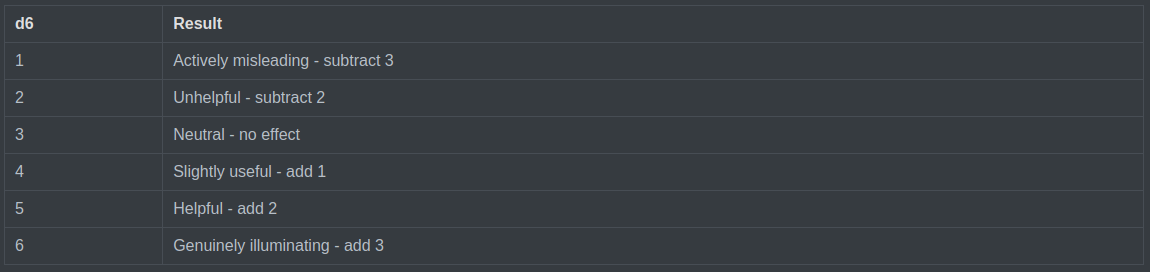
He rolls a 5 on the d6. Something in the resistance pattern clicked. Add +2 to the result. If he rolled an 8, it would now be a 10. Turns out that the information he gathered from his last failure gave him the details that lead to this turns success.
Expert - 2d6, needs 8+
Trapped door that’s likely to kill everyone within 20 feet. She rolls an 11. The door opens cleanly. She was never really worried.
Master - 2d4, needs 6+
She doesn’t think about it anymore. She rolls a 7. The door opens before anyone noticed she stopped walking.
Master - Natural Max (Double 4) + Discovery Roll
The lock opens, and something clicks in her mind alongside it. She’s felt this mechanism before, in a dream, or a memory she can’t place. She knows, suddenly, how to make one just like it.
Weight in Action
Environmental Chaos - The Hand That Shakes
The journeyman lockpick is back, +2 in hand from his near-miss. But now there’s smoke filling the corridor. Torchlight is gone. He’s working by feel alone. This adds a +2 to the threshold; his advantage and the environment’s interference cancel out. He’s back to rolling clean, threshold at 10. The world gave and the world took.
Contested Action - Two People Who Know What They’re Doing
An expert forger, 2d6, needs 8+. But the inspector examining the document is also an expert; sharp eyes, years of experience. The player adds +2 to the threshold, pushing it to 10. The forger rolls an 11. It passes, but just barely. The inspector pauses, tilts the page toward the light, then moves on. That pause meant something.
High-Stakes Compression - No Time to Think
The master lockpick needs to open the door before the footsteps reach the corner. Normally she doesn’t think about it. Now she is. The player adds +1 to her threshold, not much, she’s a master, but enough to matter. She rolls a 6. Exactly enough. The door opens as the torch rounds the corner. She’s already gone.
The Hand of Fate - Cosmic Influence
Everything is fine. No environmental pressure, no opponent, no rush. The novice sits alone in a quiet room with a simple lock and rolls a 2. Natural. Catastrophic. The pick snaps off inside the mechanism. Nobody did this to her. Sometimes the universe just says no. That’s not a flaw in the system, that’s the system being honest about how life works. The rattled nerves apply +2 positive weight to the next attempt, raising the threshold needed for success.
And that’s it. I hope you find this useful and hope you’re still out there, kicking ass and pushing forward through the pressure. Apply that weight in ways that both challenge you and push a better narrative for yourself; take care of yourself, take care of each other because, we’re all we’ve got. See you next time, hopefully with a shorter in between time.
You feel that cool and gentle hand lands back on your shoulder, ushering you back out the door and into the forest. Wiser, more competent and capable than before.
Nice and very accurate that a d20 is swingy. Your system reminds me a little of Shift and spark bound. Similar ideas I have seen in Dodge, Block, Parry.
I would argue though that a lot of your critique comes down to the fictional positioning of your character. If you are a master thief why do you even need to roll to open the door. Is there danger or context that makes it necessary. If you do fail is it because of skill, luck or something outside your control. The narrative position in this case handles the degree of complications
“But if you start applying “weight”, by manipulating the odds, (+1, -2 etc) that perfect curve gets warped. The weight acts like a magnet, dragging the results toward a specific number and skewing the distribution slightly or even so heavily that it lopsides the bell.”
This is flat out wrong. The curve of 2d6+1 is shifted up by 1, but it’s the same shape. Same for any other dice or modifier.